
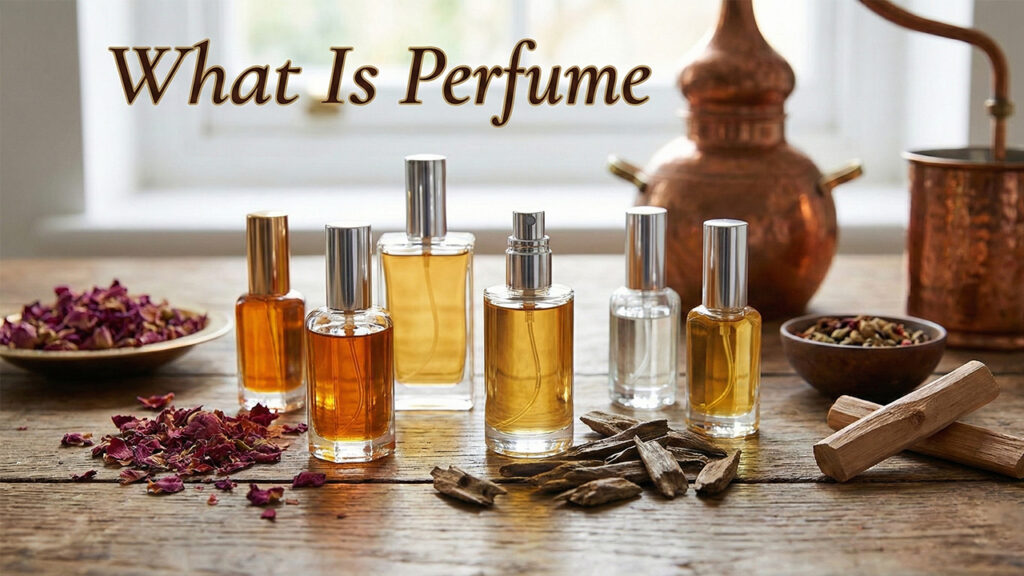
You know that feeling when a scent stops you in your tracks? Maybe it’s someone walking past wearing your grandmother’s perfume, or the smell of rain on hot pavement that takes you back to childhood summers. That’s the power of fragrance—it’s invisible, intangible, yet it can trigger emotions and memories more powerfully than almost anything else.
But what exactly is perfume? Let’s move past the marketing hype and dig into what’s really happening in that bottle.
The Chemistry Behind the Bottle
Here’s the straightforward answer: perfume is a carefully balanced mixture of aromatic compounds (the actual scent molecules), fixatives (which slow down evaporation), and a carrier—usually ethanol, though water and oils work too. The alcohol doesn’t just dilute the fragrance; it helps it diffuse into the air so people can actually smell you without getting uncomfortably close.
Modern perfumery is about 80-90% synthetic these days. Before you recoil, understand that this isn’t necessarily a bad thing. Natural jasmine absolute costs around $4,000 per kilogram and requires roughly 8 million hand-picked flowers to produce just one kilogram. Synthetic molecules can recreate that scent consistently, affordably, and without decimating flower fields. Plus, some scents—like those fresh “sea breeze” or “clean linen” notes—don’t exist in nature at all.
That said, natural ingredients still form the backbone of high-end perfumery. Sandalwood, rose otto, orris root (which takes three years to process), and real ambergris (yes, from whale digestive systems, though it’s largely banned now) create depth and complexity that synthetics are still learning to match.
How Perfume Unfolds on Your Skin
Ever noticed how a fragrance smells completely different in the bottle versus on your wrist an hour later? That’s not your imagination—it’s basic physics and chemistry at work.
Perfumes are structured in three phases:
Top notes hit you first—bright, sharp, attention-grabbing. Think citrus peels, green herbs, light fruits. These molecules are small and volatile, which means they evaporate fast, usually within the first 15 to 30 minutes. They’re the hook, the first impression, but they’re not the main story.
Heart notes emerge once those initial scents burn off. This is where the perfume’s actual character lives—florals like rose or neroli, spices like cardamom or black pepper, “green” notes that smell like crushed leaves. This phase typically lasts anywhere from 2 to 5 hours, depending on the concentration and your skin chemistry.
Base notes are the foundation. These are heavy, slow-evaporating molecules—woods, resins, musks, amber, vanilla, patchouli. They can linger for 6 to 24+ hours. If you’ve ever caught a whiff of perfume on your scarf days after wearing it, that’s base notes doing their job.
This three-tier structure isn’t just romantic perfume-speak. It’s a practical necessity. You can’t just throw 50 ingredients together and hope for the best. A skilled perfumer (often called a “nose”) balances these layers so the scent evolves gracefully instead of collapsing into chaos.
Concentration Matters More Than You Think
Not all “perfumes” are created equal, and the differences go way beyond price tags.
Parfum (or Pure Perfume): 20-30% fragrance concentration. This is the big guns. One or two dabs can last 8-12 hours or more. It’s also the most expensive because you’re getting the highest ratio of actual perfume oil to alcohol. Best for special occasions when you want serious staying power.
Eau de Parfum (EDP): 15-20% concentration. This is the sweet spot for most people—strong enough to last through a workday (6-8 hours), but not so intense that you need to apply it with a pipette. It’s become the standard for most designer and niche fragrances.
Eau de Toilette (EDT): 5-15% concentration. Lighter, fresher, more casual. Lasts about 3-5 hours. Great for summer, the office, or the gym when you don’t want to overwhelm anyone. You’ll need to reapply if you’re going from day to evening.
Eau de Cologne: 2-4% concentration. Originally from Cologne, Germany (hence the name). This is basically scented alcohol—refreshing, fleeting, gone in about 2 hours. Think old-school barbershop splashes.
Here’s what most people don’t realize: a higher concentration doesn’t just mean longer wear time. It often means a different scent profile altogether. The same fragrance in Parfum versus EDT can smell noticeably different because perfumers adjust the formula for each concentration. The EDT version might emphasize brighter top notes, while the Parfum version goes deeper and richer.
| Type | Concentration | Longevity | Best For |
| Parfum | 20% – 30% | 8+ Hours | Weddings, Formal Events |
| Eau de Parfum (EDP) | 15% – 20% | 6 – 8 Hours | Daily wear, Evening |
| Eau de Toilette (EDT) | 5% – 15% | 3 – 5 Hours | Summer, Office, Gym |
| Eau de Cologne | 2% – 4% | 2 Hours | Refreshing splash |
How Perfume is Actually Made
Making perfume is part chemistry lab, part art studio, part years-long obsession.
Extraction is where it starts. Steam distillation is the classic method—you blast plant material with steam, collect the vapor, cool it down, and out comes essential oil. Solvent extraction uses chemicals (like hexane) to pull out delicate scents from flowers that can’t handle heat. Enfleurage, the old-fashioned method of pressing flowers into fat, is almost extinct now—too labor-intensive and expensive.
Blending is where the magic happens. A master perfumer might work with a palette of 1,500+ raw materials. Creating a new fragrance can take anywhere from several months to several years. They’re not just mixing randomly; they’re thinking about how molecules interact, how the scent will develop over time, how it performs on skin versus fabric, even how it smells in different climates. Temperature and humidity massively affect how fragrance behaves.
Aging (maceration) comes next. The blended concentrate sits in tanks for weeks or even months. This isn’t superstition—the molecules need time to bind and harmonize. Rush this step and you get a fragrance that smells disjointed, like the ingredients are fighting each other.
Dilution is the final step. The concentrate gets mixed with alcohol (and sometimes a bit of water) to reach the target concentration. Then it’s filtered, bottled, and shipped.
One interesting development: AI is now being used in perfume creation. IBM and other companies have developed algorithms that analyze successful fragrances and suggest new combinations. Controversial? Absolutely. But it’s happening.
Why We Actually Wear Fragrance
The practical answer is obvious—we want to smell good. But there’s more going on beneath the surface.
Our olfactory system is hardwired directly to the limbic system, the brain’s emotion and memory center. This is why scent triggers memories more powerfully than sight or sound. It’s not poetry; it’s neuroscience. A specific perfume can instantly transport you back to a specific moment—your first date, your mother’s closet, a hotel lobby in Paris.
Certain scents have measurable psychological effects. Lavender has been shown in multiple studies to reduce cortisol levels (the stress hormone). Citrus scents can increase alertness and energy. Vanilla tends to create feelings of comfort and warmth. Peppermint can improve focus and concentration.
There’s also the identity factor. What you wear becomes part of how people remember you. It’s personal branding, whether you’re conscious of it or not. Some people stick with one signature scent for decades. Others rotate seasonally or by mood. There’s no right answer—it’s entirely subjective.
And yes, attraction plays a role. While the idea of “human pheromones” in perfume is mostly marketing nonsense (human pheromone science is still murky at best), certain musky and woody notes do register as warm and inviting. The real trick is finding something that works with your natural scent, not against it.
The Skin Chemistry Factor
This is why you can’t just buy a perfume because it smells amazing on your friend. Your skin’s pH level, moisture content, diet, medications, even your hormonal cycle—all of these affect how a fragrance develops on you.
Dry skin doesn’t hold scent as well as moisturized skin. Oily skin amplifies fragrance. Skin with a higher pH tends to make fragrances smell sharper or more acidic. This is also why perfume smells different on a test strip versus your actual wrist.
The only way to really know if a fragrance works for you is to wear it for a full day. Spray it on your pulse points (wrists, neck, inside elbows—anywhere blood flows close to the skin and generates heat), then go live your life. Check in after 30 minutes, after 2 hours, after 5 hours. See what survives. See what you still like.
Making Your Fragrance Last
Quick practical tips that actually work:
- Apply right after showering while your skin is still slightly damp. The moisture helps lock in the scent.
- Layer with unscented or matching lotion. Dry skin = fragrance evaporates faster.
- Spray on your clothes and hair (carefully—alcohol can damage some fabrics). These hold scent longer than skin.
- Don’t rub your wrists together. I know everyone does it, but it crushes the fragrance molecules and makes them dissipate faster.
- Store bottles in a cool, dark place. NOT the bathroom—heat and humidity are perfume killers. That medicine cabinet? Bad idea.
Oil-Based vs. Alcohol-Based: What’s the Difference?
Traditional perfumes use alcohol as the carrier because it projects well—it evaporates and carries the scent into the air around you. This is great for making an entrance.
Oil-based fragrances (like traditional attars) sit closer to the skin. They don’t project as far, but they last longer and evolve more slowly. They’re also less likely to irritate sensitive skin since there’s no alcohol to dry things out. The downside? They can feel heavier and don’t work as well in hot, humid weather.
Neither is objectively better. It depends on what you want—projection or intimacy, quick evolution or slow burn.
Finding What Actually Works for You
Forget about finding one “signature scent” if that feels limiting. Some people wear different fragrances for different seasons, different occasions, different moods. That’s completely valid.
If you’re new to fragrance, start by identifying what you’re naturally drawn to. Do you like the smell of fresh laundry, coffee, vanilla candles, the forest after rain, old books, leather jackets? Those preferences point you toward fragrance families—fresh/clean, gourmand, woody, leathery.
Sample before you commit. Most fragrance retailers will give you samples, or you can order discovery sets online. Wear each one for a full day before deciding. What smells sophisticated in the store might give you a headache by lunchtime.
And trust your gut. If a fragrance is trendy but you hate wearing it, don’t force it. The whole point is to enjoy it.